Cleveland Clinic Florida
- Location
- Weston
- Nearest airport
- FLL (20 min) / MIA (25–35 min)
- Drive time
- 20 min from FLL via I-595
- Specialty context
- Cardiac, orthopedic, neurological, digestive disease. Multi-day stays common for out-of-state patients.
Cleveland Clinic Weston · Bascom Palmer · Jackson Memorial · Moffitt · Mayo Clinic · Baptist Health
Private car service for patients traveling to Florida medical facilities for procedures, consultations, and ongoing treatment. Airport-to-hospital transfers, hospital-to-hotel, hotel-to-appointment, and recurring ride accounts for chemotherapy, dialysis, and physical therapy schedules. Also serving visiting physicians, medical conference attendees, and pharmaceutical representatives covering Florida territory.
Book Your Ride
Custom quoteFlorida is a destination for medical care. Patients fly in from across the country and internationally for cardiac surgery at Cleveland Clinic Weston, cancer treatment at Moffitt in Tampa and Sylvester in Miami, eye procedures at Bascom Palmer, diagnostic workups at Mayo Clinic Jacksonville, and orthopedic procedures at Baptist Health facilities. These patients need ground transportation that accounts for their medical situation — not a rideshare driver who drops off at the curb and leaves.
Medical transportation through Florida Car Service is a private car service built around three operational realities: patients arriving by air need a direct, comfortable transfer from the airport to the hospital or hotel without navigating rental car counters; patients in active treatment need recurring rides on a fixed weekly schedule with the same chauffeur and account-based billing so nobody pays per ride at the point of service; and patients leaving procedures cannot always walk unassisted, need a vehicle they can enter without climbing, and need a chauffeur who waits at the facility exit rather than circling the block.
The service also covers the medical professionals who make Florida healthcare work: visiting surgeons performing procedures at facilities outside their home institution, pharmaceutical representatives covering a multi-city Florida territory, and physicians and researchers attending conferences at the Miami Beach Convention Center or the Orange County Convention Center in Orlando. These professionals need reliable ground transportation that arrives on time and bills to a corporate or practice account.
Every medical transport booking includes door-to-door service (chauffeur meets at the facility exit or hotel lobby, not at a curb), wheelchair-to-vehicle assistance coordination for patients with mobility limitations, flexible wait time because medical appointments run late, and a smooth-ride priority that avoids potholes, hard stops, and aggressive lane changes — details that matter when the passenger just had surgery.
Named facilities with airport proximity, drive times, and the transport patterns we handle for each. Chauffeurs assigned to medical transport know the patient pickup and discharge entrances at every facility listed below.
Each scenario has specific vehicle, timing, and assistance requirements. The booking coordinator matches the right vehicle and chauffeur to the medical situation.
Patients discharged after outpatient or short-stay procedures need a vehicle that does not require climbing, a chauffeur who provides a steady arm from the wheelchair to the vehicle, and a ride focused on comfort rather than speed. The Executive SUV (Cadillac Escalade or Lincoln Navigator) is the default for post-surgical patients: wider door opening, higher seat position for easier entry without deep bending, and suspension that smooths out road imperfections on I-95 and I-595.
Cleveland Clinic Weston discharge: Chauffeur positions at the patient discharge entrance on Cleveland Clinic Boulevard. Hospital staff wheels the patient to the vehicle; the chauffeur assists with vehicle entry and loads any belongings. Baptist Hospital Kendall discharge: Patient pickup at the ground-level discharge area off SW 88th Street. Bascom Palmer discharge: Chauffeur meets at the ground-floor patient exit. Patients after eye procedures often wear protective shields and have limited vision — the chauffeur guides them directly to the vehicle.
Chemotherapy patients at Sylvester Comprehensive Cancer Center in Miami and Moffitt Cancer Center in Tampa typically receive treatment on a fixed weekly or biweekly cycle. These patients need consistent, reliable transport because they often feel fatigued or nauseous after treatment and cannot drive themselves home. A recurring account with same-chauffeur priority ensures the patient is not explaining their situation to a new driver every week.
Typical Sylvester schedule: Tuesday pickup at 8:15 AM from a Coral Gables or Coconut Grove residence. Drop-off at Sylvester on NW 14th Street. The chauffeur waits or returns at approximately 1:00 PM for the ride home. Treatment sessions vary in length, so the return pickup is flexible — the patient texts when nearing completion. Moffitt schedule: Patients from across Florida fly into TPA and stay at nearby hotels during multi-week treatment. Daily hotel-to-Moffitt rides at 7:30 AM with returns after treatment. One account, one monthly invoice, same chauffeur all week.
Bascom Palmer Eye Institute at 900 NW 17th Street in Miami draws patients nationally and internationally for cataract removal, retinal detachment repair, glaucoma surgery, and corneal transplants. After any eye procedure, the patient cannot drive — often for 24 hours or longer. Many patients fly in specifically for a procedure, meaning they have no local family member to drive them.
The transport pattern is typically a two-part booking: arrival day (MIA or FLL to a hotel near Bascom Palmer or directly to the institute for a pre-op appointment) and procedure day (hotel to Bascom Palmer in the morning, Bascom Palmer to hotel after the procedure, with a potential follow-up appointment the next day before the return airport transfer). The chauffeur on procedure day meets at the patient exit, helps guide the patient — who may have a protective eye shield and blurred vision — to the vehicle, and drives at reduced speed with attention to smooth braking.
Knee and hip replacement patients face a specific vehicle challenge: getting into and out of a car when you cannot bend your leg past 90 degrees. A standard sedan sits too low. The Executive SUV solves this with a step-in height that allows the patient to sit without deep knee flexion, a door opening wide enough to accommodate a walker or crutches, and interior space to extend the operated leg during the ride.
Cleveland Clinic Weston: Orthopedic patients are often discharged one to two days after surgery. The SUV positions at the discharge entrance. Physical therapy sessions begin within days, creating a recurring transport pattern: residence to PT facility and back, three times per week for four to six weeks. Baptist Hospital Kendall: Similar pattern for patients in south Miami-Dade. PT facilities along US-1 and Kendall Drive. AdventHealth Orlando: Orthopedic patients in Central Florida with PT appointments across the Orlando metro area.
Patients recovering from cardiac surgery or cardiac events at Cleveland Clinic Weston, Jackson Memorial, Tampa General Hospital, or Mount Sinai Miami Beach often enter a multi-week cardiac rehabilitation program. Rehab sessions run two to three times per week for six to twelve weeks. Patients are medically cleared to ride in a vehicle but not to drive themselves, creating a recurring transport need identical in structure to chemotherapy rides.
The account manager sets standing rides at the rehab schedule times. The chauffeur drives conservatively — smooth acceleration, gentle braking, climate set to the patient's preference. For patients at Cleveland Clinic Weston cardiac rehab, the ride from a Weston or Pembroke Pines residence is typically under 15 minutes. For patients rehabbing at Mount Sinai Miami Beach, the ride from a South Beach or Mid-Beach hotel runs five to ten minutes. Monthly billing to the patient account or a family member eliminates per-ride payment friction during recovery.
Patients and their families flying in for treatment need to know the drive time from the airport to the facility. These are the corridors we run most frequently, with realistic drive-time ranges that account for Florida traffic patterns.
25–35 min
Via I-75 and I-595. Traffic peaks 7–9 AM and 4–7 PM on I-75.
15–20 min
Via NW 12th Avenue. Short ride from MIA; midday traffic minimal.
10–15 min
Via NW 14th Street. Closest major hospital to MIA.
15 min
Via I-95 or US-1. Direct route south from the airport.
20 min
Via I-595 West. Against rush-hour traffic in the morning.
20 min
Via Veterans Expressway to Bruce B. Downs Boulevard.
20 min
Via I-95 South to San Pablo Road exit. Light traffic outside rush hour.
15 min
Via SR-528 (BeachLine) to I-4 North. Fast connection from the airport.
15 min
Via Crosstown Expressway to Davis Islands. Direct route from TPA.
20–30 min
Via Julia Tuttle Causeway (I-195). Traffic-dependent, especially weekends.
All airport pickups include real-time flight tracking. If the inbound flight is delayed, the pickup time adjusts automatically at no extra cost. Complimentary wait time: 60 minutes for international arrivals, 30 minutes for domestic. The chauffeur meets at baggage claim with a name board — not at the curb.
Patients with ongoing treatment — weekly chemotherapy at Sylvester or Moffitt, three-times-weekly dialysis at a Broward County clinic, biweekly physical therapy after orthopedic surgery, or cardiac rehab sessions at Cleveland Clinic Weston — need a transport arrangement that removes per-ride booking friction entirely. The recurring appointment account does this.
Setup: The patient, a family member, or the treating practice calls +1-305-555-0100 and provides the treatment schedule: days, times, pickup address, and facility address. The account manager enters standing rides into dispatch. The same chauffeur is assigned to all rides on the account when scheduling allows — patients undergoing chemotherapy or dialysis consistently report that seeing the same driver each visit reduces stress during an already difficult routine.
Billing: All rides on a recurring account consolidate to a single monthly invoice. The invoice is sent to the patient, a designated family member, or the medical practice — depending on who set up the account. There are no per-ride charges at the point of service. For patients with treatment plans spanning months, this eliminates dozens of individual payment transactions and provides a single document for insurance reimbursement claims.
Schedule changes:Treatment schedules shift. An oncologist moves a Tuesday infusion to Thursday. A PT session gets rescheduled from morning to afternoon. The patient or practice calls the account manager, and the standing ride adjusts. No cancellation fees for medical-schedule changes made with at least four hours' notice.
Many medical transport bookings originate not from the patient but from the medical practice. A patient coordinator at Cleveland Clinic Weston arranges surgery dates for out-of-state patients and needs ground transportation from FLL or MIA to the clinic on the arrival day. A surgical scheduling team at Bascom Palmer books post-procedure transport for patients who cannot drive after eye surgery. An oncology practice at Sylvester sets up recurring rides for a patient beginning a six-month chemotherapy protocol.
Single point of contact: The practice receives a dedicated account manager with a direct phone number and email. The coordinator books rides the same way every time — call, email, or an online portal. No app downloads, no consumer-facing booking flow, no account creation per patient.
HIPAA-aware operations: Ride records contain pickup address, drop-off address, pickup time, passenger first name, and a contact number. No diagnosis, procedure type, physician name, insurance information, or medical record number appears anywhere in the booking system. Invoices sent to the practice show ride details by date and reference number — patient name appears only if the practice explicitly requests it. The chauffeur does not ask about the nature of the appointment and does not log medical information.
Practice-billed accounts: The practice can set up a billing account so individual patients are not charged at pickup. All rides booked by the practice roll into a single monthly invoice to the practice, tagged by patient reference number or date. This is particularly useful for concierge medicine practices in Miami and Fort Lauderdale where transportation is bundled into the patient's concierge fee.
Florida's medical infrastructure draws thousands of medical professionals annually — not just patients. Three transport patterns recur consistently.
Surgeons performing procedures at Florida facilities outside their home institution — a visiting cardiac surgeon at Cleveland Clinic Weston, a consulting neurologist at Jackson Memorial, a retinal specialist at Bascom Palmer. Airport pickup at MIA, FLL, TPA, or JAX with direct transfer to the hospital or hotel. Multi-day stays with daily hotel-to-hospital rides on a standing schedule. Billed to the physician's practice or the hosting institution.
Pharma reps covering Florida territory visit multiple medical offices, hospitals, and clinics in a single day. A typical South Florida loop: morning appointments at physician offices in Miami and Coral Gables, midday at a Fort Lauderdale clinic, afternoon at Memorial Healthcare in Hollywood, evening departure from FLL. The hourly charter model works well — the chauffeur stays with the rep all day, handles parking at medical offices, and the rep works between stops.
The Miami Beach Convention Center and Orange County Convention Center (OCCC) in Orlando host major medical conferences year-round. Physicians, researchers, and industry professionals arriving at MIA or MCO need airport-to-hotel and hotel-to-convention-center transport. Group bookings for department delegations use the Mercedes-Benz Sprinter (up to 12 passengers). Individual sedan or SUV service for keynote speakers and VIP attendees. Billed to the institution or corporate account.
Vehicle choice matters more in medical transport than in any other service category. A post-surgical patient needs a different vehicle than a physician heading to a conference. The booking coordinator recommends based on the medical situation.

Cadillac Escalade / Lincoln Navigator
Recommended for post-surgical patients. Wider door, higher seat, smoother ride. Easiest entry for knee/hip replacement recovery.

Mercedes-Benz S-Class / BMW 7 Series
Routine medical appointments, physician travel, pharma rep territory runs. Comfortable for patients who can enter a standard vehicle.

Mercedes-Benz E-Class / BMW 5 Series
Follow-up appointments, medical conference transport, patient companion travel. Standard for recurring non-surgical rides.
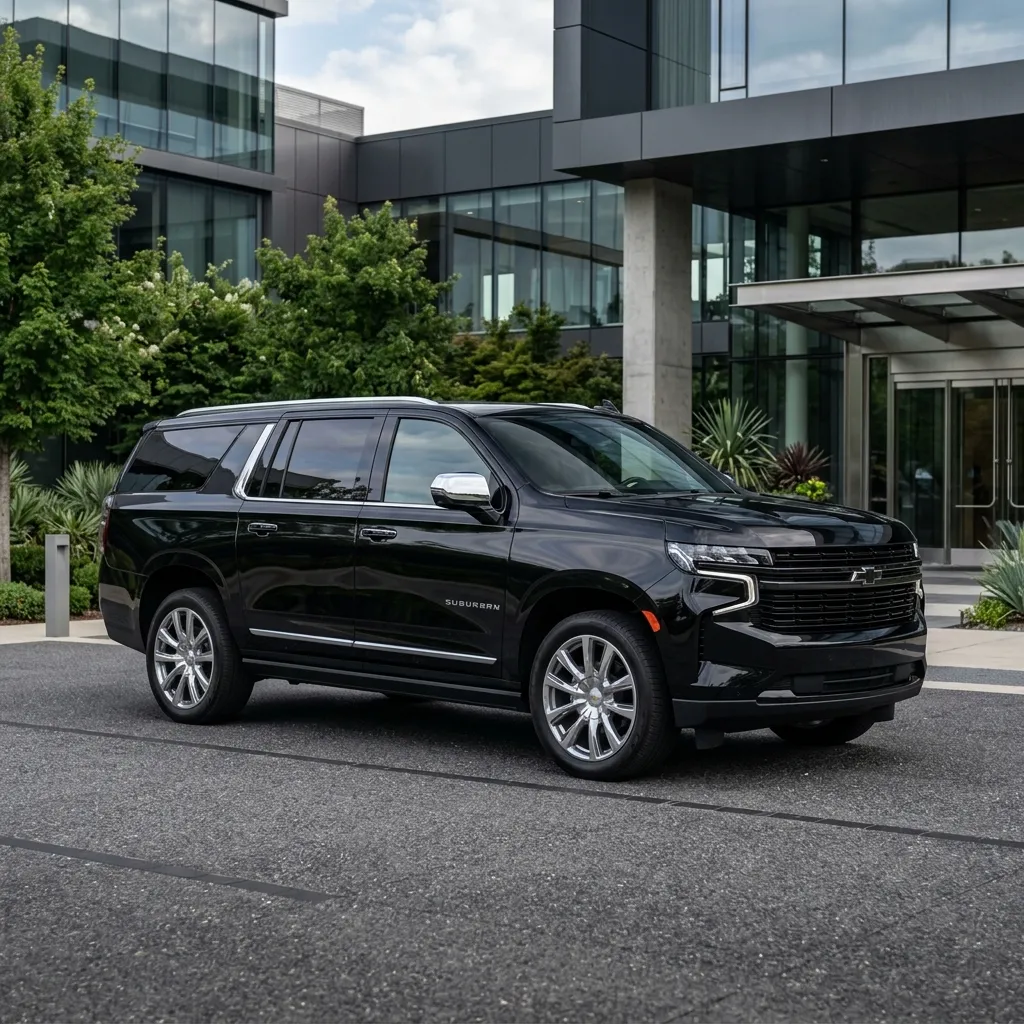
Chevrolet Suburban / GMC Yukon XL
Patients traveling with family members and luggage for multi-day treatment stays. Room for medical equipment bags.

Mercedes-Benz Sprinter Executive
Medical conference group transport. Department delegations, hospital system team travel, pharma rep regional meetings.
Full fleet details, including interior photos and dimensions: view the complete fleet.
These operational details are standard on every medical transport ride, whether a one-time airport-to-hospital transfer or a recurring weekly account.
The chauffeur meets at the hospital discharge exit, hotel lobby entrance, or residence front door — not at a curb or parking lot. For airport arrivals, meet-and-greet at baggage claim with a name board. No patient navigates a parking garage alone.
Chauffeurs on medical transport assignments drive conservatively: smooth acceleration, gradual braking, no aggressive lane changes. Route selection avoids construction zones and rough road surfaces when alternate routes are available. This matters when the passenger just had abdominal surgery or a retinal procedure.
The chauffeur assists with the transfer from wheelchair to vehicle at the facility exit. Folding wheelchairs are loaded into the trunk or cargo area. The chauffeur provides a steady arm and opens doors. This is physical assistance, not medical aid — licensed medical lift is outside the scope of a car service.
Medical appointments run late. Every medical transport booking includes 30 minutes of built-in wait time beyond the scheduled pickup. For longer waits, the patient texts the chauffeur with an updated estimate. No per-minute penalty during the included buffer. Extended waits beyond the buffer bill at the hourly charter rate.
No medical information in ride records. Pickup address, drop-off address, time, and a first name. The chauffeur does not ask about the appointment. Practice-billed invoices show reference numbers, not patient details, unless explicitly requested by the practice.
Recurring medical accounts are assigned a primary chauffeur. The same driver picks up the same patient every week for chemotherapy, dialysis, PT, or cardiac rehab. Patients in active treatment benefit from consistency — the chauffeur learns the routine, the timing, and the patient preferences without being told each time.
Medical transport pricing follows two models depending on the booking pattern. One-time transfers — airport to hospital, hospital to hotel, hotel to airport — are priced as point-to-point rides based on distance and vehicle class, identical to a standard airport transfer booking.
Recurring appointment accounts — weekly chemotherapy, dialysis three times per week, biweekly physical therapy — receive volume-based pricing. The per-ride rate decreases as the weekly ride count increases. A patient with three dialysis rides per week pays less per ride than a one-time airport transfer on the same route. The rate is set during account setup and locked for the treatment duration unless the schedule changes materially.
Practice-billed accounts: Medical practices that book on behalf of multiple patients receive practice-level pricing. A concierge medicine practice in Miami booking 20 patient rides per month receives a different rate structure than an individual patient booking occasional rides. The practice receives a single monthly invoice covering all patient rides.
What is not included: Gratuity (discretionary), tolls on the Florida Turnpike and express lanes (passed through at cost), and extended wait time beyond the included 30-minute buffer (billed at the hourly charter rate). There is no surge pricing — a ride to Cleveland Clinic Weston during morning rush hour costs the same as the same ride at 2:00 PM.
Book now using the form below or call +1-305-555-0100 with your transport needs. Describe the medical situation — vehicle recommendation and pricing will be tailored to the specifics.
Tell us about the medical facility, the travel dates, and whether this is a one-time transfer or a recurring appointment schedule. The booking coordinator will respond within two hours during business hours.
Book your Florida chauffeur in under a minute
Prefer to speak directly? Call +1-305-555-0100 — medical transport requests are handled with priority.
Answers to the questions patients, families, and medical practices ask most frequently about medical transport in Florida.
The chauffeur assists with folding and loading a personal wheelchair into the vehicle trunk or cargo area. For patients arriving at Bascom Palmer Eye Institute after a procedure, the chauffeur meets at the facility exit, loads the wheelchair, and assists the patient into the vehicle. The chauffeur is not a licensed medical aide and cannot perform medical lifts, but door-to-door physical assistance — steady arm, opening doors, managing the wheelchair between the building entrance and the vehicle — is standard on every medical transport booking.
The Executive SUV (Cadillac Escalade / Lincoln Navigator) provides the most comfortable post-surgical ride. The rear seats recline, the step-in height accommodates patients with limited mobility after knee or hip replacement, and the suspension absorbs road imperfections better than a sedan. For patients returning from Cleveland Clinic Weston after outpatient procedures, the SUV is the default recommendation. Sedan rear seats do not fully recline but offer more legroom than rideshare vehicles.
Ride records contain only the information needed for dispatch: pickup address, drop-off address, pickup time, passenger first name, and a contact phone number. No medical information, procedure type, diagnosis, or physician name appears in the booking system, the dispatch record, or the invoice. The chauffeur does not ask about the nature of the appointment. For practice-billed accounts, invoices show the practice name and a ride reference number — not the patient name — unless the practice specifically requests patient-name line items.
Yes. Medical practices, patient coordinators, and concierge medicine offices book directly by calling +1-305-555-0100 or emailing the account manager. Cleveland Clinic Weston patient coordinators and Bascom Palmer surgical scheduling teams regularly book transport for out-of-state patients arriving at MIA or FLL. The coordinator provides pickup location, time, destination, and a patient contact number. The patient receives a confirmation text with the chauffeur name and vehicle details.
The patient or the oncology practice sets up a recurring account. A standing weekly ride is entered into dispatch — for example, every Tuesday at 8:15 AM from a Coral Gables residence to Sylvester Comprehensive Cancer Center on NW 14th Street in Miami, with a return ride at approximately 1:00 PM. The chauffeur assignment stays consistent so the patient sees the same driver each week. If the appointment time shifts, the patient or practice calls the account manager to adjust. Billing runs monthly to the account, not per-ride to the patient.
Florida Car Service is a private car service, not a medical transport provider reimbursed by insurance. We do not bill insurance carriers directly. Some patients submit ride receipts to their insurance for out-of-network transportation reimbursement — the monthly invoice provides the documentation needed for a claim. Patients should check with their insurance carrier about non-emergency medical transportation coverage before relying on reimbursement.
Small pets in carriers are permitted in the vehicle. Patients traveling from out of state for extended treatment at Moffitt Cancer Center in Tampa or Mayo Clinic in Jacksonville sometimes bring a companion animal. The pet must remain in a carrier during the ride. Service animals are always permitted without restriction. Let the booking coordinator know at the time of reservation so the chauffeur can prepare the vehicle.
Medical appointment wait times are unpredictable. On every medical transport booking, the chauffeur waits at the facility for the patient rather than departing and returning. There is no per-minute penalty for the first 30 minutes beyond the estimated pickup time. For appointments at Jackson Memorial or Tampa General Hospital where wait times can extend further, the patient texts the chauffeur with an updated estimate. Hourly charter billing applies for extended waits beyond the included buffer.
Yes. Bascom Palmer at 900 NW 17th Street in Miami is the number-one ranked ophthalmology program in the country, and many patients fly in from out of state for procedures. After cataract surgery, LASIK, retinal procedures, or glaucoma surgery, patients cannot drive. The chauffeur picks up from Bascom Palmer's patient exit on the ground floor, assists with door-to-vehicle transfer, and drives to the patient's hotel or residence. MIA to Bascom Palmer is a 10-to-15-minute ride; FLL to Bascom Palmer runs 35 to 45 minutes via I-95.
Cleveland Clinic Florida in Weston sits at 2950 Cleveland Clinic Boulevard, about 20 minutes from FLL and 25 to 35 minutes from MIA depending on I-75 and I-595 traffic. Patients flying in for cardiac surgery, orthopedic procedures, or specialist consultations land at FLL or MIA and need a direct transfer to the clinic or a nearby hotel. The chauffeur drops off at the main entrance on Cleveland Clinic Boulevard. For multi-day stays, the account manager sets up daily rides between the hotel and the clinic at scheduled appointment times.
Yes. Dialysis patients typically need transport three times per week on a fixed schedule. The account manager enters standing rides — for example, Monday-Wednesday-Friday at 6:30 AM from a Hollywood residence to a DaVita or Fresenius clinic in Pembroke Pines, with return transport at approximately 11:00 AM. Same-chauffeur assignment is prioritized. Monthly billing consolidates all rides into a single invoice sent to the patient, a family member, or a designated payer.
The Executive SUV is the standard vehicle for orthopedic recovery patients. The Cadillac Escalade has a step-in height and door width that accommodates patients using a walker or crutches. The chauffeur opens the door fully, provides a steady arm, and allows the patient to enter at their own pace. For patients leaving Cleveland Clinic Weston or Baptist Hospital Kendall after joint replacement, the SUV is pre-positioned at the patient discharge entrance. A sedan is not recommended for the first two weeks post-surgery due to the lower seat height.
Medical transport connects to every part of our Florida network. These pages provide additional detail on airport pickup protocols, city-specific service areas, and related transport options.
Private chauffeured airport transfers across MIA, FLL, MCO, TPA, JAX, PBI, RSW, and EYW with flight tracking and meet-and-greet at arrivals.
Account-based corporate car service with monthly billing, NDA chauffeurs, and dedicated account management across Florida.
Chauffeured hourly bookings with a two-hour minimum for multi-stop itineraries, extended medical appointments, and full-day transport.
Airport-to-hospital transfers, recurring appointment accounts, post-surgical transport, and physician travel — all with door-to-door service, flexible wait times, and monthly billing. From a single ride to Cleveland Clinic Weston to a six-month chemotherapy schedule at Sylvester, one account handles it.
Serving Cleveland Clinic Weston, Bascom Palmer Eye Institute, Jackson Memorial, Sylvester Cancer Center, Moffitt Cancer Center, Mayo Clinic Jacksonville, AdventHealth Orlando, Tampa General Hospital, Mount Sinai Miami Beach, Baptist Health South Florida, and Memorial Healthcare System.